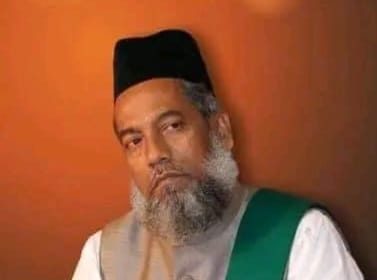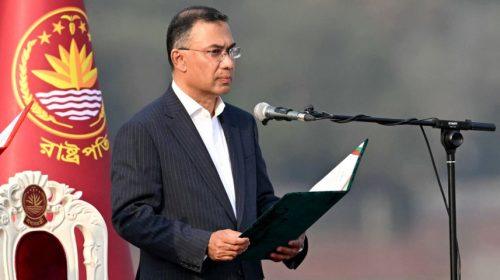

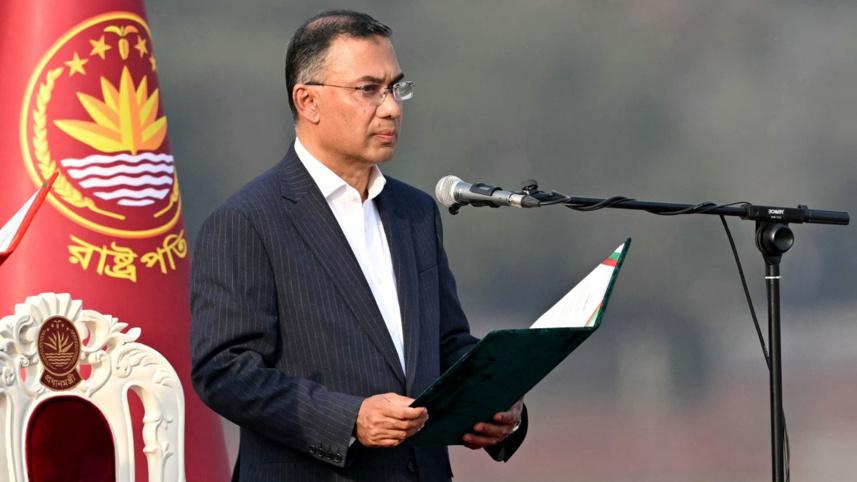
For the first time since independence, a third member of the same political family has taken the country’s helm, with Tarique Rahman having become Bangladesh’s first male prime minister in 35 years.
Tarique took over as the BNP chairman after his mother, former prime minister and party chair Khaleda Zia, passed away on December 30 last year.
However, Tarique’s ascent to power was anything but easy, shaped by the trauma of his father’s assassination, and then his long years in exile, all the while facing persistent accusations of corruption and nepotism from his political detractors.
His father, late president Ziaur Rahman, who founded the BNP in 1978, was assassinated in a military coup in 1981 when Tarique was a teenager.
Having spent his childhood and adolescence in Dhaka, Tarique became a member of Bogura’s Gabtali upazila BNP in 1988 at the age of 22. However, he got involved in politics before he formally joined the party and had even taken to the streets with his mother during the 1990 anti-Ershad movement.
In 1994, Tarique married Zubaida Rahman, the daughter of the former Bangladesh Navy chief and a two-time minister in subsequent governments, late Rear Admiral Mahbub Ali Khan. They have a daughter — Barrister Zaima Zarnaz Rahman.
Tarique was made the first joint secretary of the party in June 2002, around a year after the BNP returned to power in 2001 with Khaleda as the prime minister.
Three years later, he convened a countrywide grassroots forum that covered every upazila. He visited all the upazilas, addressed grassroots leaders and activists, and had one-on-one conversations with locals.
It was during this period that Tarique was embroiled in controversy.
He was accused of running “Hawa Bhaban”, dubbed an alternative power centre during the BNP-led coalition rule. He was also blamed for using his power to gain personal advantage.
Tarique consistently refuted all the allegations against him.
He was arrested on corruption charges during the military-backed caretaker government rule in 2007 and was reportedly tortured in custody for 18 months.
Archival news reports from that year said he suffered fractures in the spine and fell sick during multiple court appearances. He was finally granted bail on medical grounds on August 28, 2008, and was released from jail on September 3 that year.
A week later, he left for London with his wife and daughter for medical treatment while facing multiple criminal cases at home.
On December 8, 2009, the BNP national council elected Tarique as senior vice-chairman, ignoring the party charter that stipulates election to the posts. He was re-elected to the position at the sixth national council in 2016.
Earlier, on January 7, 2015, the High Court banned publishing, broadcasting, or reproducing speeches and statements by Tarique in all print, electronic, and social media as long as he remained absconding in London.
That year, tragedy struck again when his younger brother Arafat Rahman Koko passed away.
While in exile, he continued to shape the BNP’s strategy and policies and served as the party’s acting chairman after his mother was sentenced to prison in 2018.
Since then, he has led the party virtually from London, attending meetings and overseeing key organisational decisions.
According to his associates, Tarique gradually grew more measured, as years in exile left their mark on him — shaping his vision of greater tolerance in Bangladeshi politics.
He was convicted in absentia in five cases and faced a flurry of lawsuits, but all charges and rulings against him were dropped after the ouster of the AL government — clearing the legal barrier to his return.
Tarique returned home on December 25 last year to an ecstatic welcome. Addressing a massive crowd, he said, “… I have a plan for the people of my country, for my country,” indicating his readiness to lead.
And thus began the party’s campaign.
To strengthen the party’s position, he attended numerous programmes across the country, addressing 64 public rallies, seeking votes for the “Sheaf of Paddy”, the BNP’s electoral symbol.
He made dozens of area-specific pledges, assuring people of job creation, welfare, healthcare, and the development of infrastructure and agriculture. His party also pledged to establish an accountable and “just state”, directly answerable to people.
Tarique, nicknamed “Pinu”, was born on November 20,1967. After completing his initial studies at Dhaka’s BAF Shaheen College, he was enrolled in the international relations department of Dhaka University in the 1980s.
In his election affidavit, his educational qualification was mentioned as “higher secondary.”
Source- The Daily Star